Most of the battles a forest fights never make a sound that reaches us. There is no roar, no chase across an open plain, nothing that a film crew would wait a whole season to capture. There is only a tree, a few birds, and a quarrel over a hole in the wood. On one warm spring morning I found myself standing under exactly such a tree, and the few hours that followed turned into one of the most complete pieces of behaviour I have ever been allowed to watch from beginning to end.
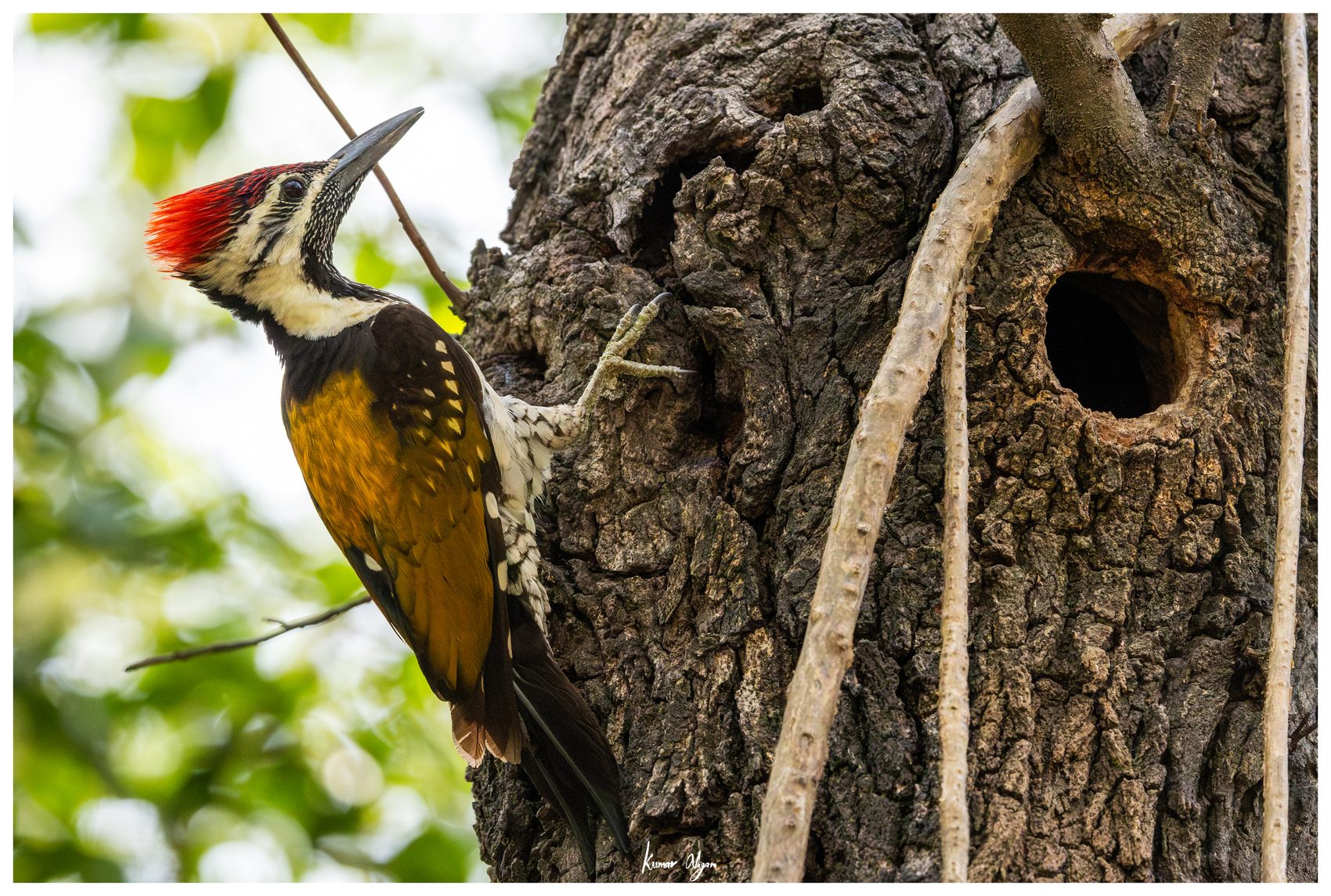
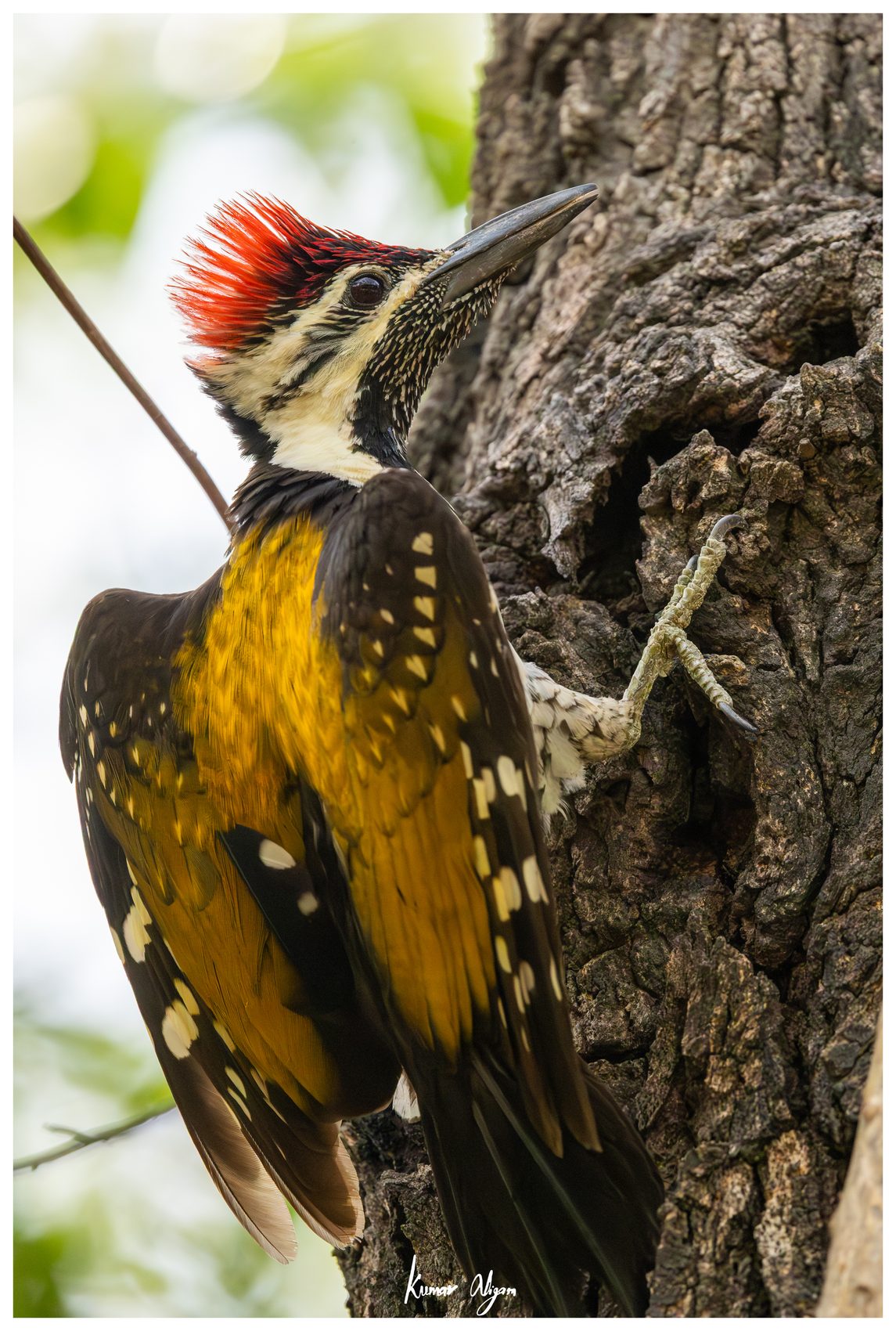
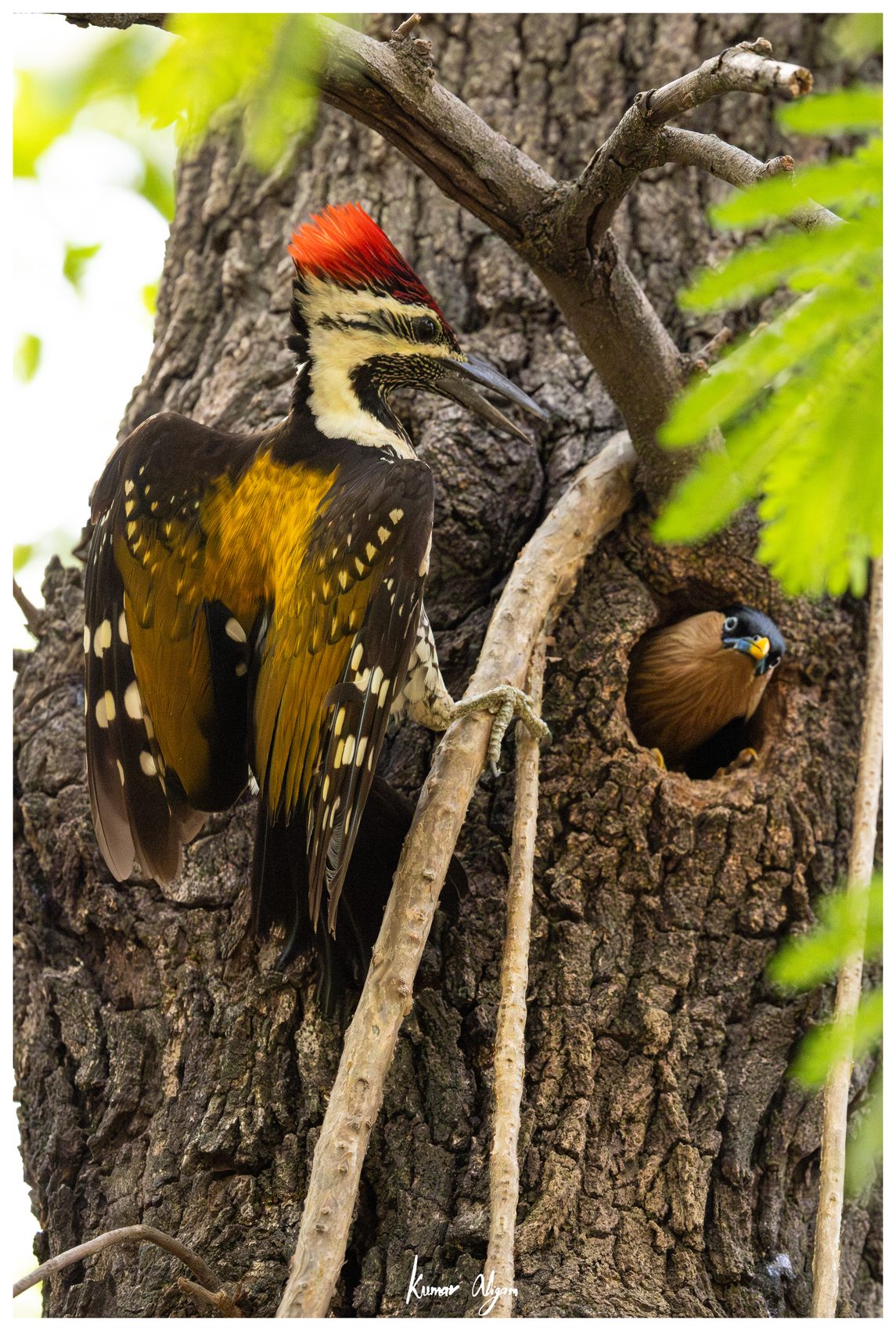
The cast was small. On one side stood a Black-rumped Flameback, the golden backed woodpecker with the bright red crest and the loud, laughing call that most people in India have heard long before they ever manage to see the bird. On the other side was a pair of Brahminy Starlings, soft and sandy coloured, with a little black crest that they raise whenever they are excited, which on this particular morning was very nearly all the time.
What they were fighting over was not food, and it was not territory in the way we usually picture it. It was a single cavity in an old trunk, a one room home, and the right to raise a family inside it. If you have ever watched a property dispute play out slowly between neighbours, you already understand most of what happened next.
Chapter One
Weeks of Hard Work
A woodpecker does not move into a home. It makes one. While most birds gather grass and twigs and build outward, a Flameback does the opposite. It chooses a tree strong enough to keep its future chicks safe, and then it begins to dig.
For several days this male had been carving. Using its bill like a chisel and its stiff tail as a brace, it had taken the wood away piece by piece until a clean round doorway appeared on the trunk, with a deep chamber hidden behind it. To a passing eye it looks like nothing more than a hole. To the bird that made it, it stands for days of labour, a great deal of energy, and the whole hope of the coming season. In the language of property, he was the rare kind of owner who had built the house with his own two hands, one careful strike at a time.
Chapter Two
Someone Was Watching
All of that work, it turned out, had not gone unnoticed.
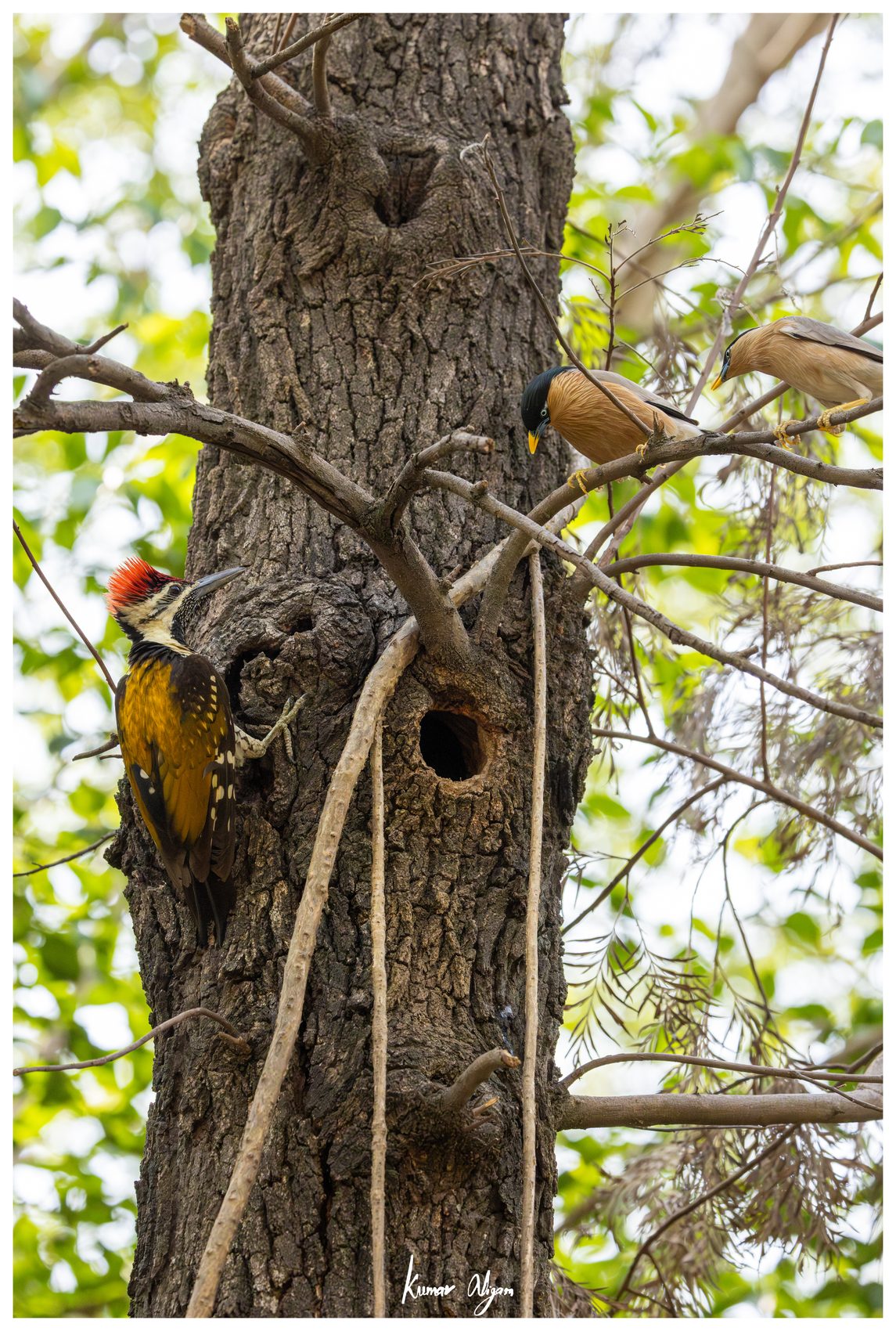
A pair of Brahminy Starlings had begun to visit the tree. They were not there to dig anything of their own. Starlings cannot excavate. They are what biologists call secondary cavity nesters, which is a polite way of saying that they wait for somebody else to do the difficult part, and then look for a way to move in.
A natural hollow is hard to come by. A freshly cut cavity, clean and dry and exactly the right size, is the kind of thing a house hunting couple only dreams about. The starlings had found precisely what they were looking for, and they settled onto a nearby branch to keep an eye on it.
Chapter Three
The Inspection Begins
Over the next while the visits grew more frequent, and a good deal bolder.
The starlings perched close to the entrance and followed every move the woodpecker made. They noted when he went inside. They noted when he came back out. They measured the distance between their branch and his doorway the way buyers pace out a room they have already quietly decided to take. None of this was idle curiosity. They were learning his routine, and they were waiting for the gap in it.
Chapter Four
Testing the Defender
The first real challenge was almost polite.
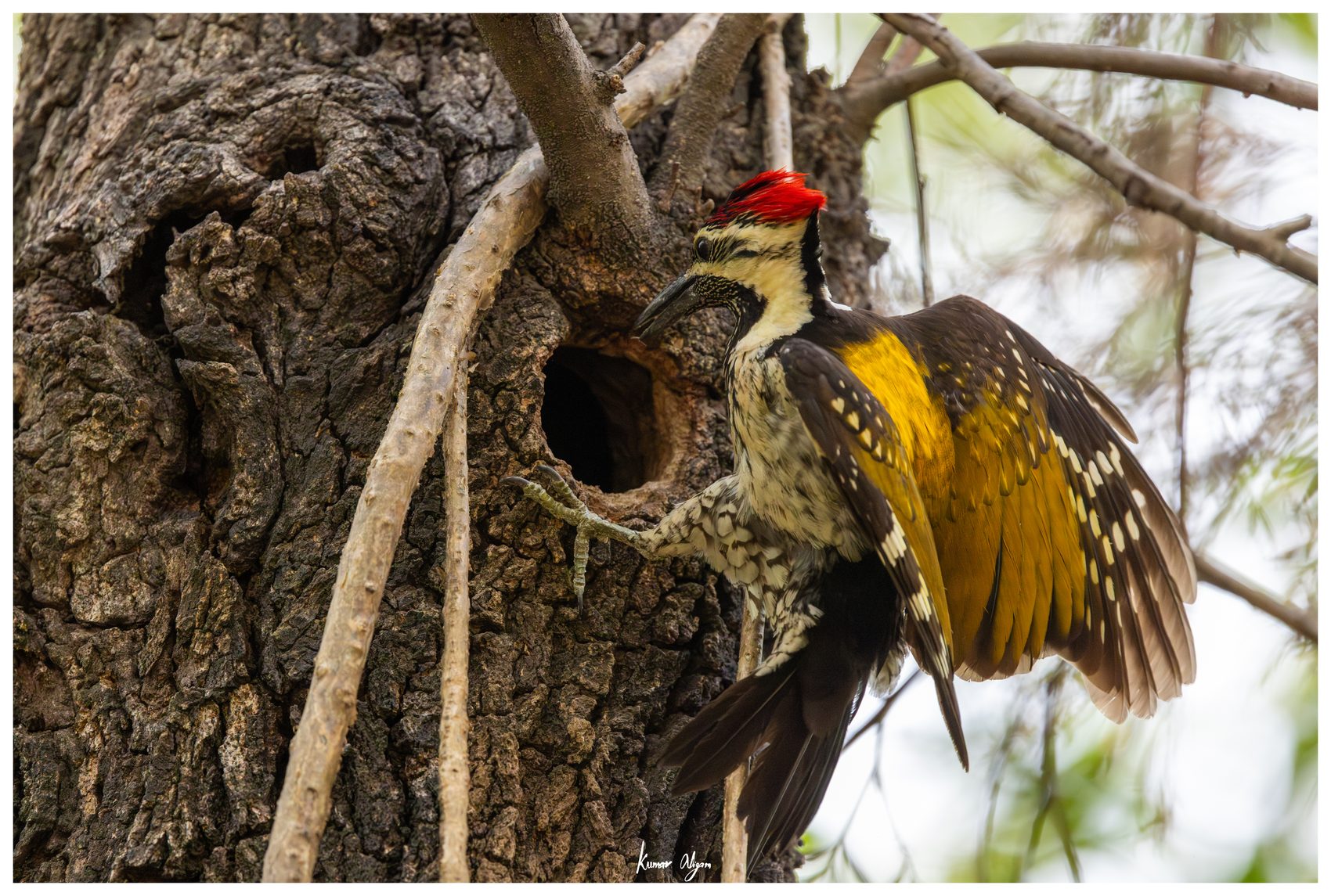
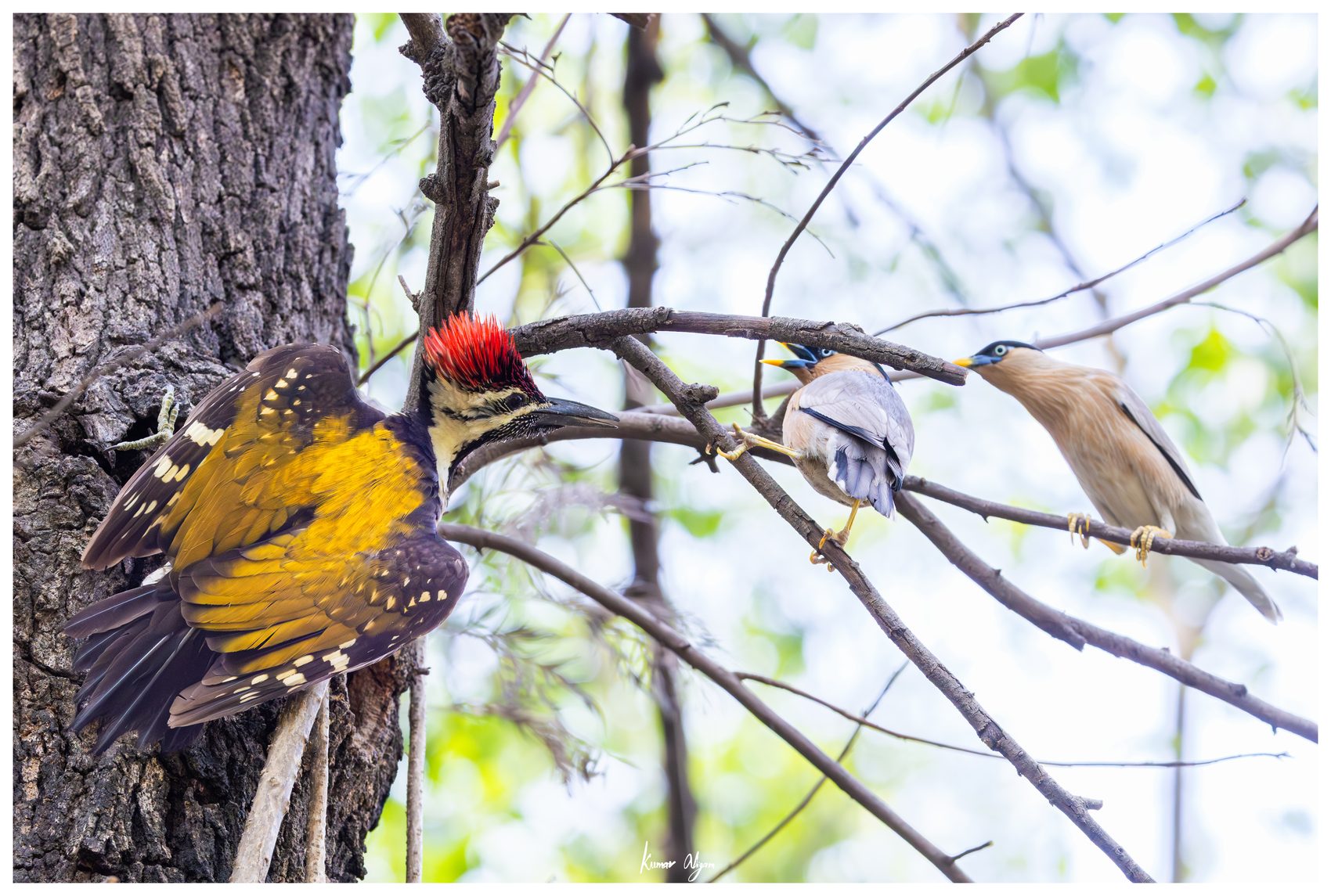
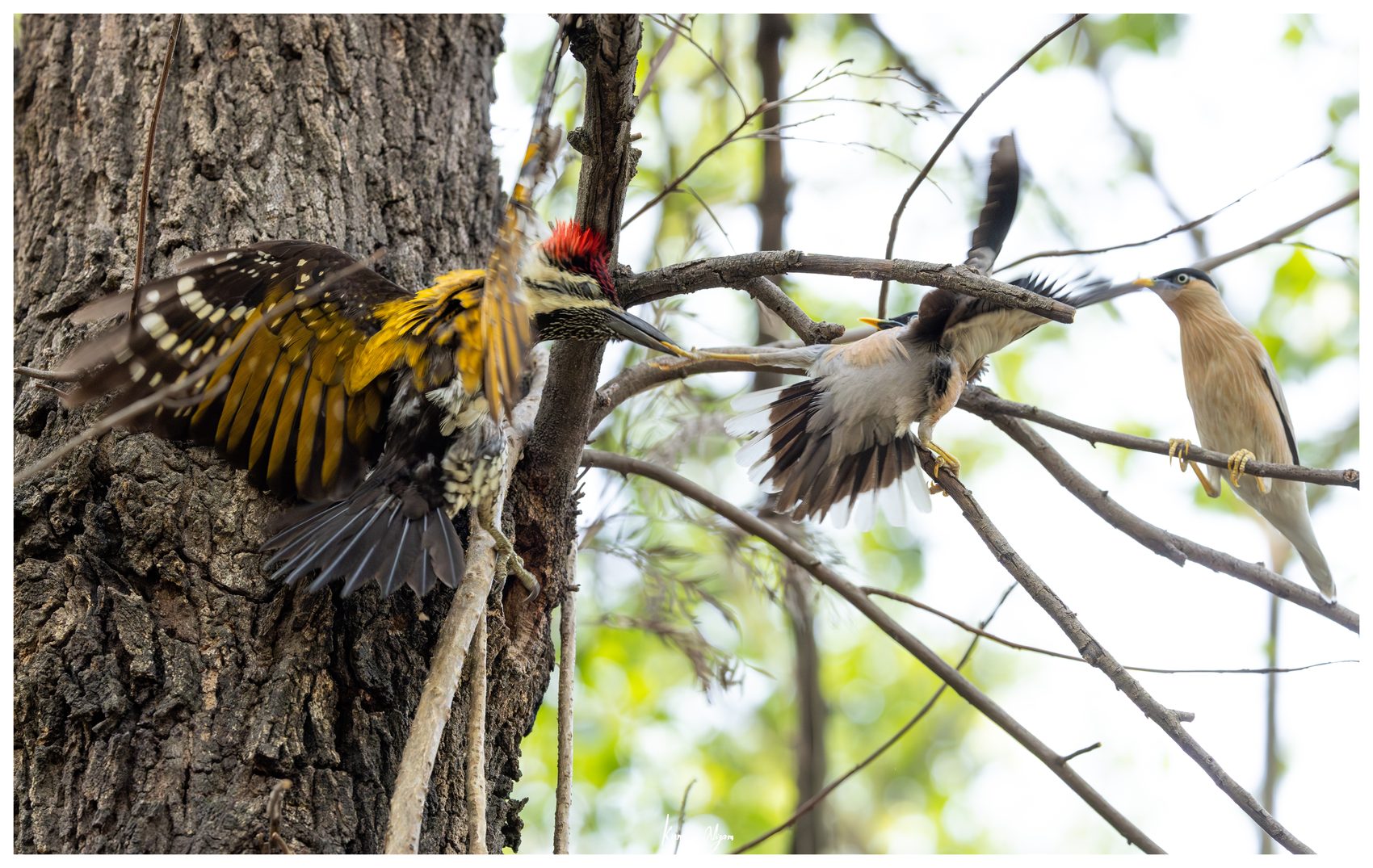
One starling edged closer than it had dared before. The Flameback answered at once. It spread its wings wide, lifted its scarlet crest, and turned to face the intruder head on. For a woodpecker this display does two jobs at the same time. It makes the bird look far larger than it really is, and it sends a clear signal to any rival that the home already has an owner. The meaning was simple enough for anyone to read. This address is taken.
Chapter Five
Strength Versus Persistence
The starlings, to their credit, were not easily impressed.
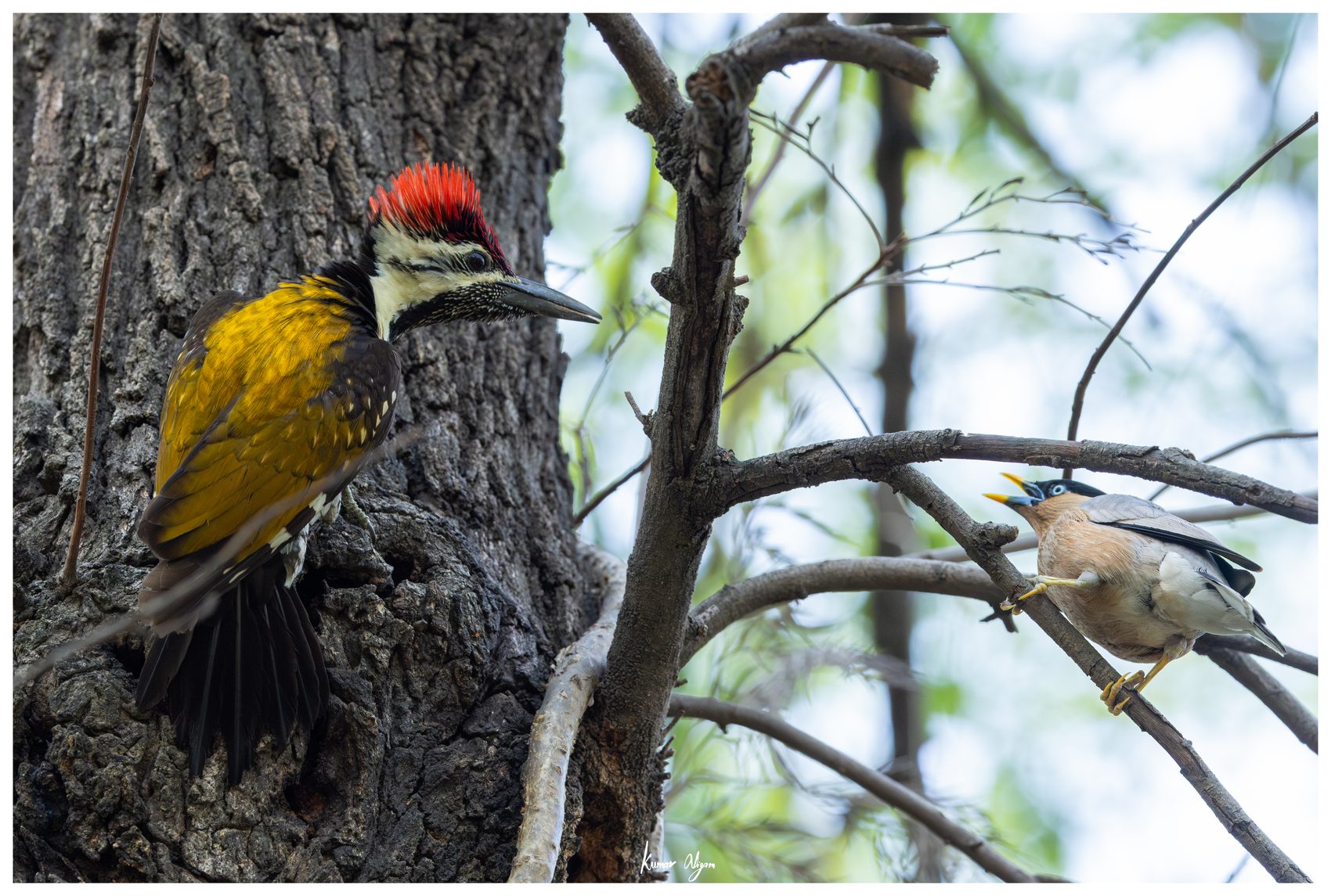
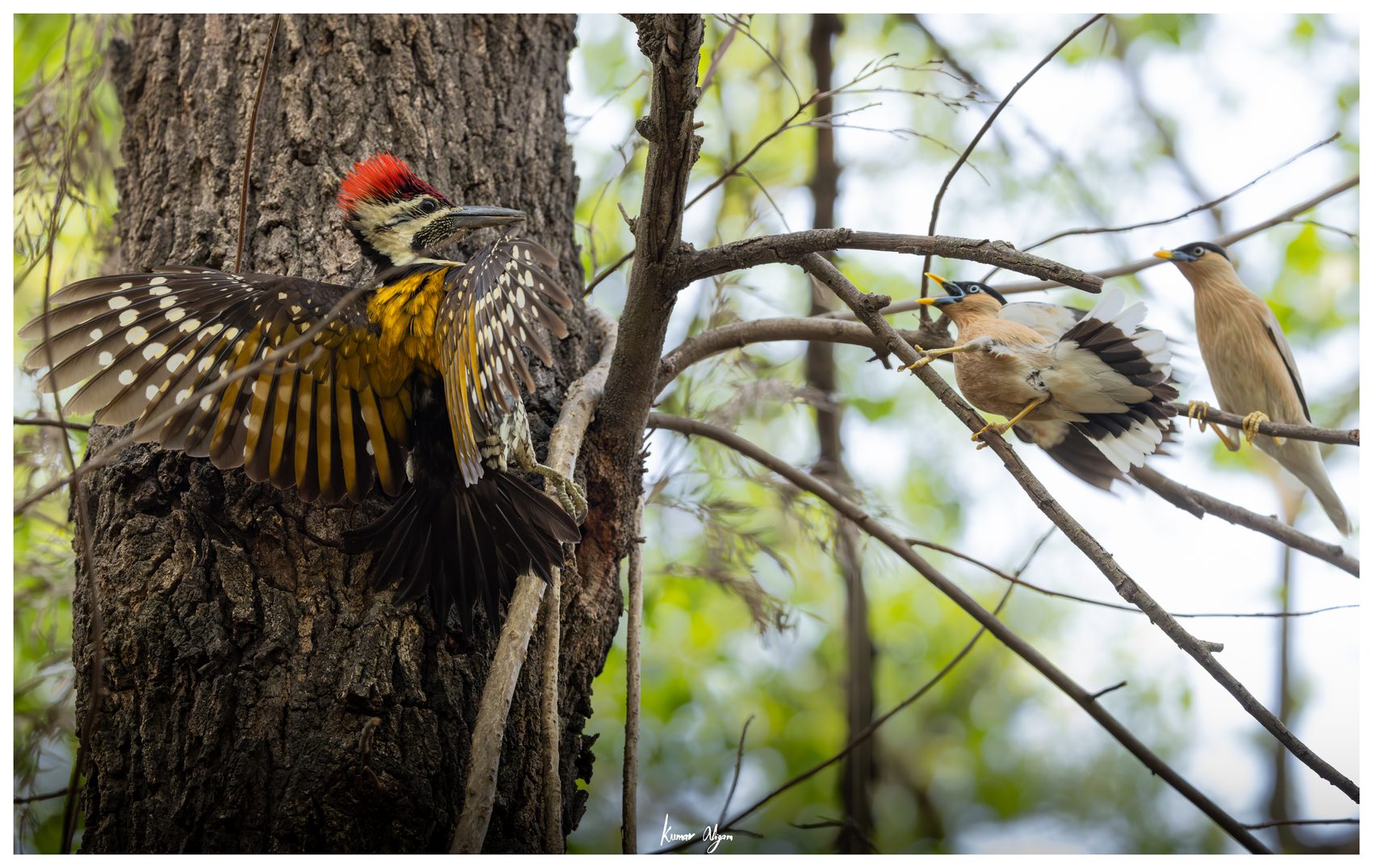
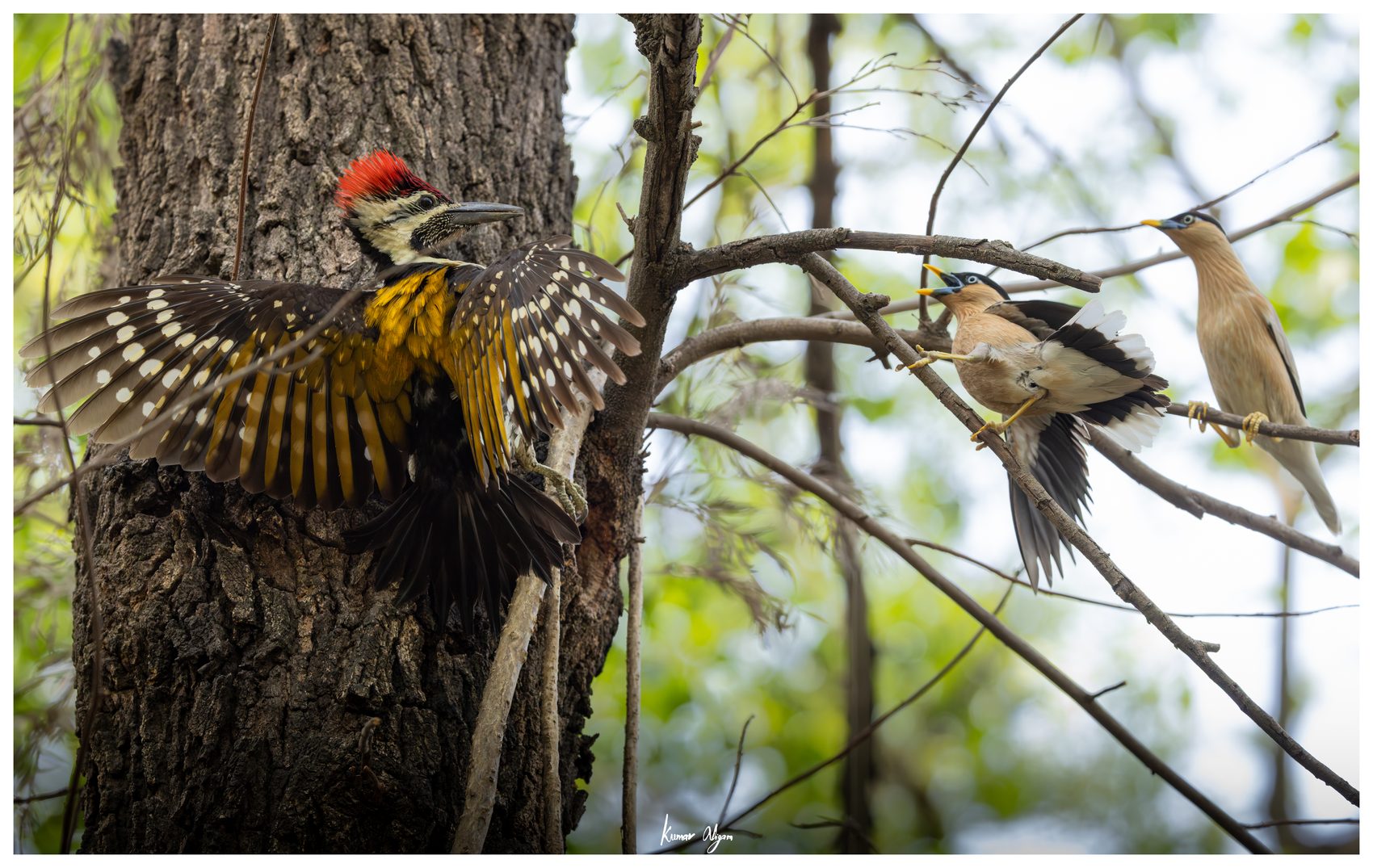
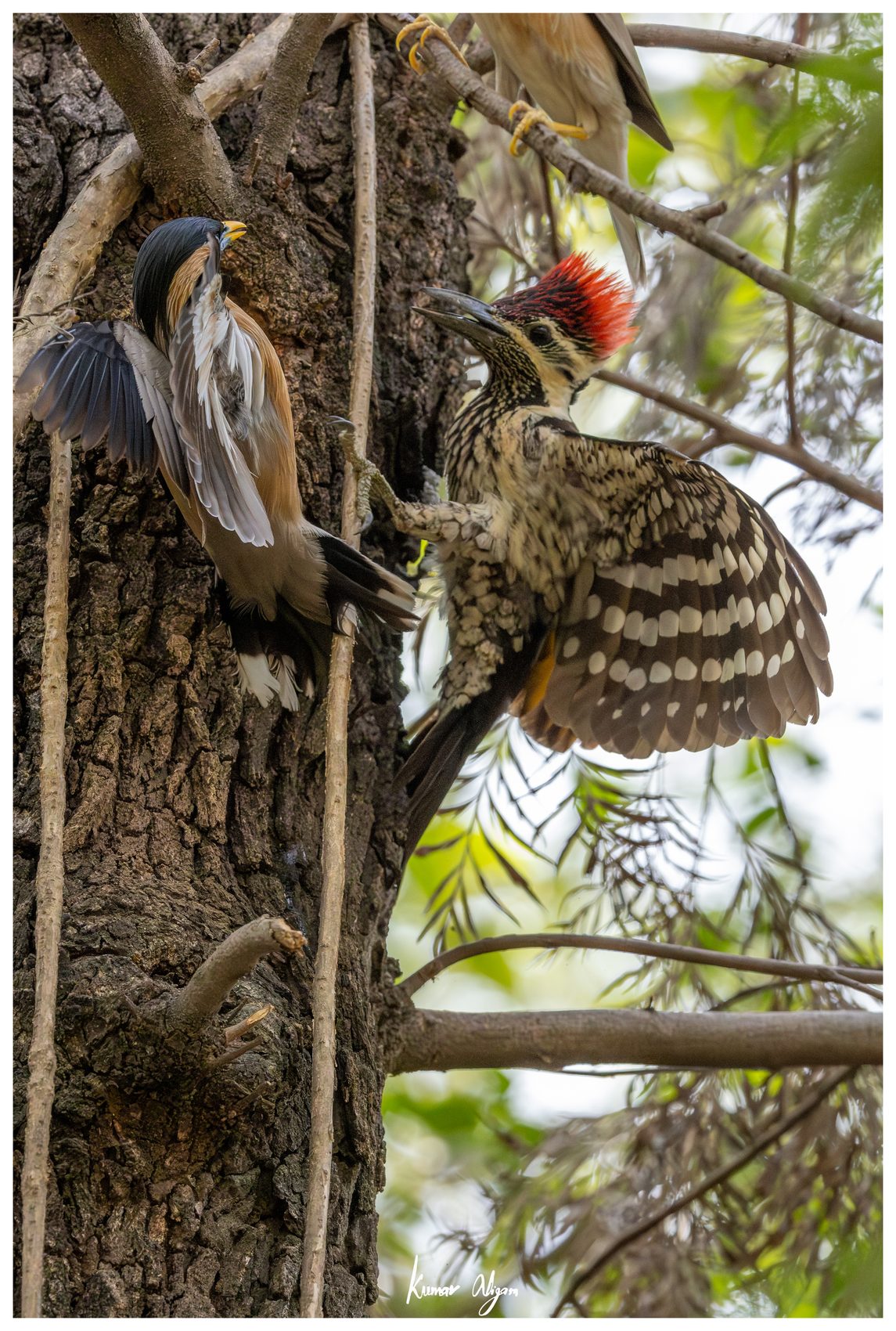
Rather than meeting the woodpecker's strength with strength, which would have been a poor idea, they leaned on the one advantage they actually had, which was numbers and patience. One of them would draw the owner's attention to a branch on the right. The other would quietly shift to the left. Every time the Flameback turned to face one threat, the second crept a little closer to the door.
This is where the gap between the two birds became plain. The woodpecker was clearly the stronger, built for hammering into hardwood and more than able to drive off a single rival. The starlings were lighter and weaker, but there were two of them, and they had decided to simply outlast him.
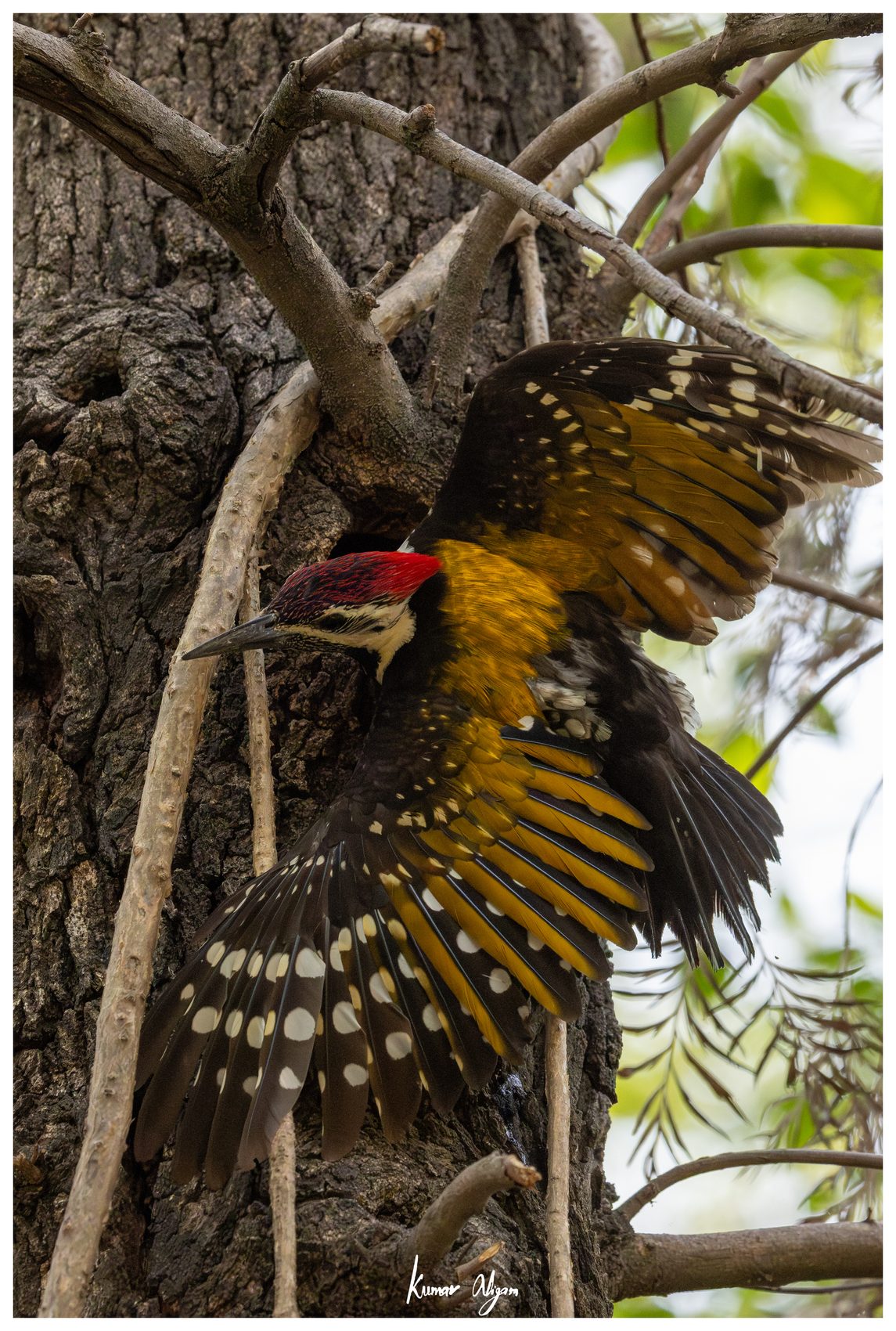
Chapter Six
The Siege
What followed is the part that does not fit neatly into a few photographs, because it simply went on, and on, for hours.
Neither side was willing to walk away. The woodpecker guarded every angle of approach to the cavity, lunging and displaying each time a starling drifted too near. The starlings kept coming back, calling loudly, switching branches, feeling for the one small mistake they were certain he would eventually make.
There is a quiet lesson in a standoff like this one. In the wild, the win does not always go to the strongest body in the fight. Often enough it goes to whoever is willing to stay the longest, and the starlings had very plainly come to stay.
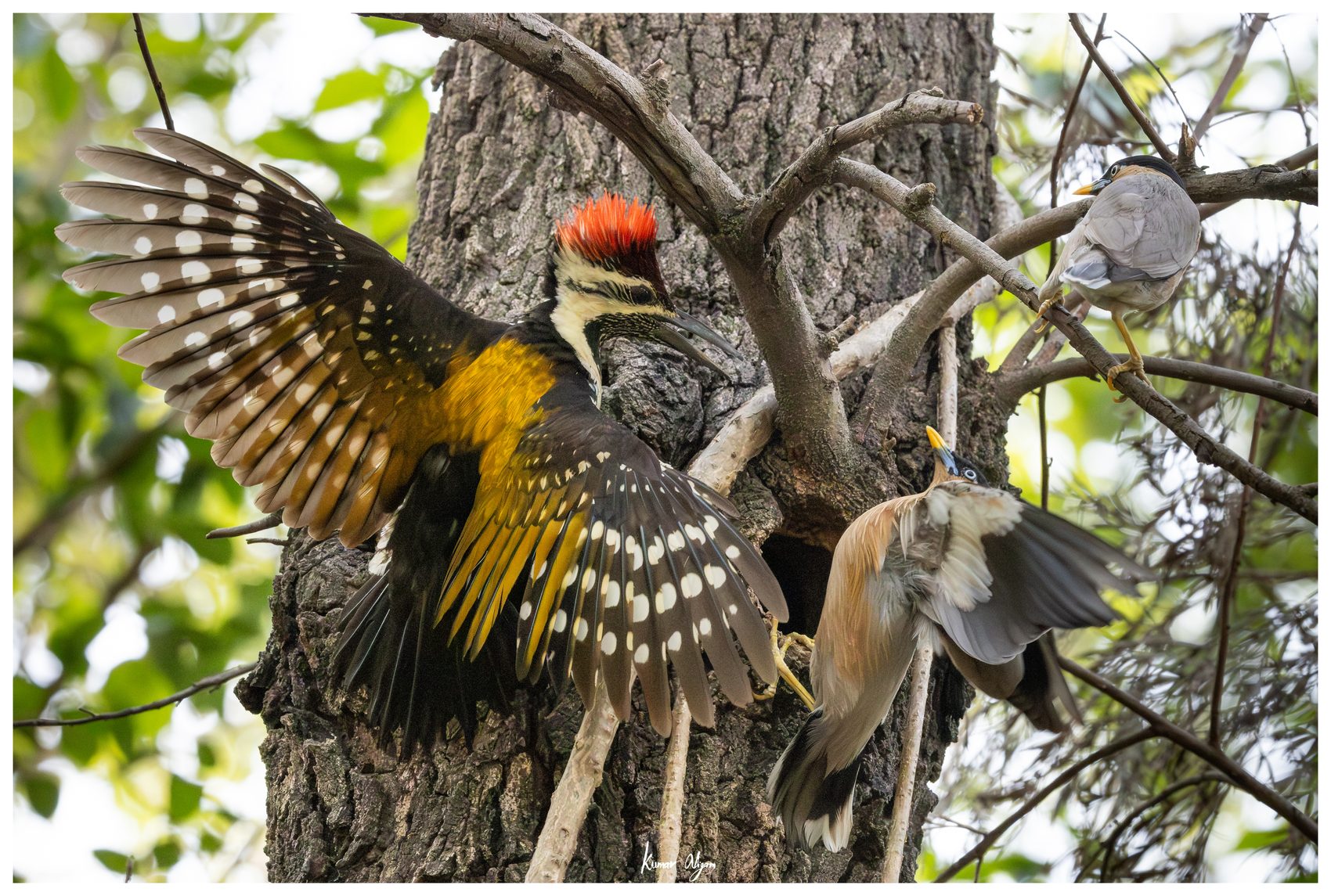
In the wild, the win does not always go to the strongest body in the fight. It goes to whoever is willing to stay the longest.
Chapter Seven
A Brief Opening
And then, after all those hours, the mistake arrived.
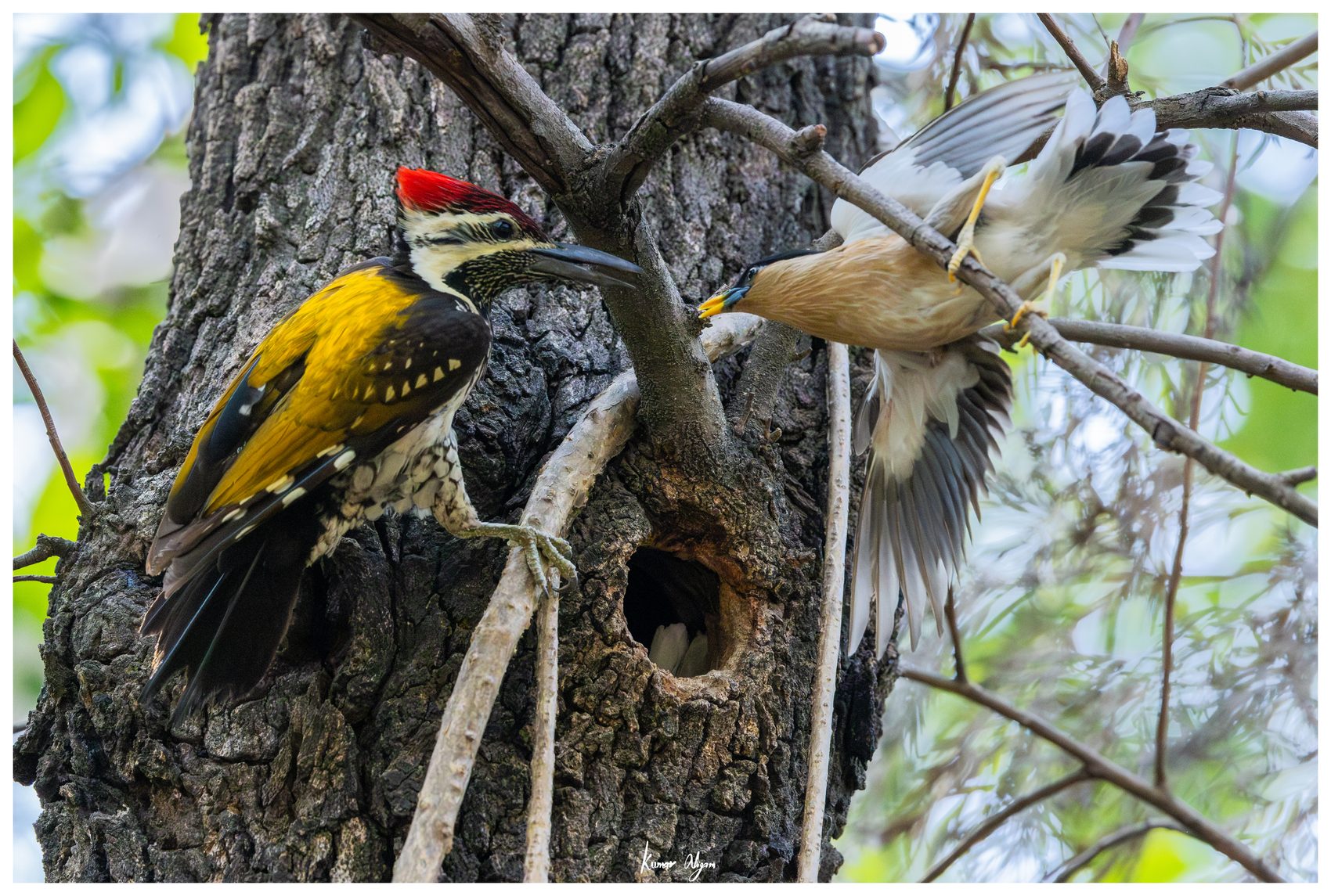
The Flameback left the doorway. It was only for a moment, the kind of short absence that had probably happened a hundred times already that morning without costing him anything. This time the starlings were ready. The instant he was clear of the entrance, one of them broke for the cavity while the other held its place nearby, watching the trunk like a lookout posted on a street corner.
Everything that had looked like noisy, scattered harassment suddenly made sense. It had not been random at all. It had been a plan, and the two of them had been rehearsing it all morning.
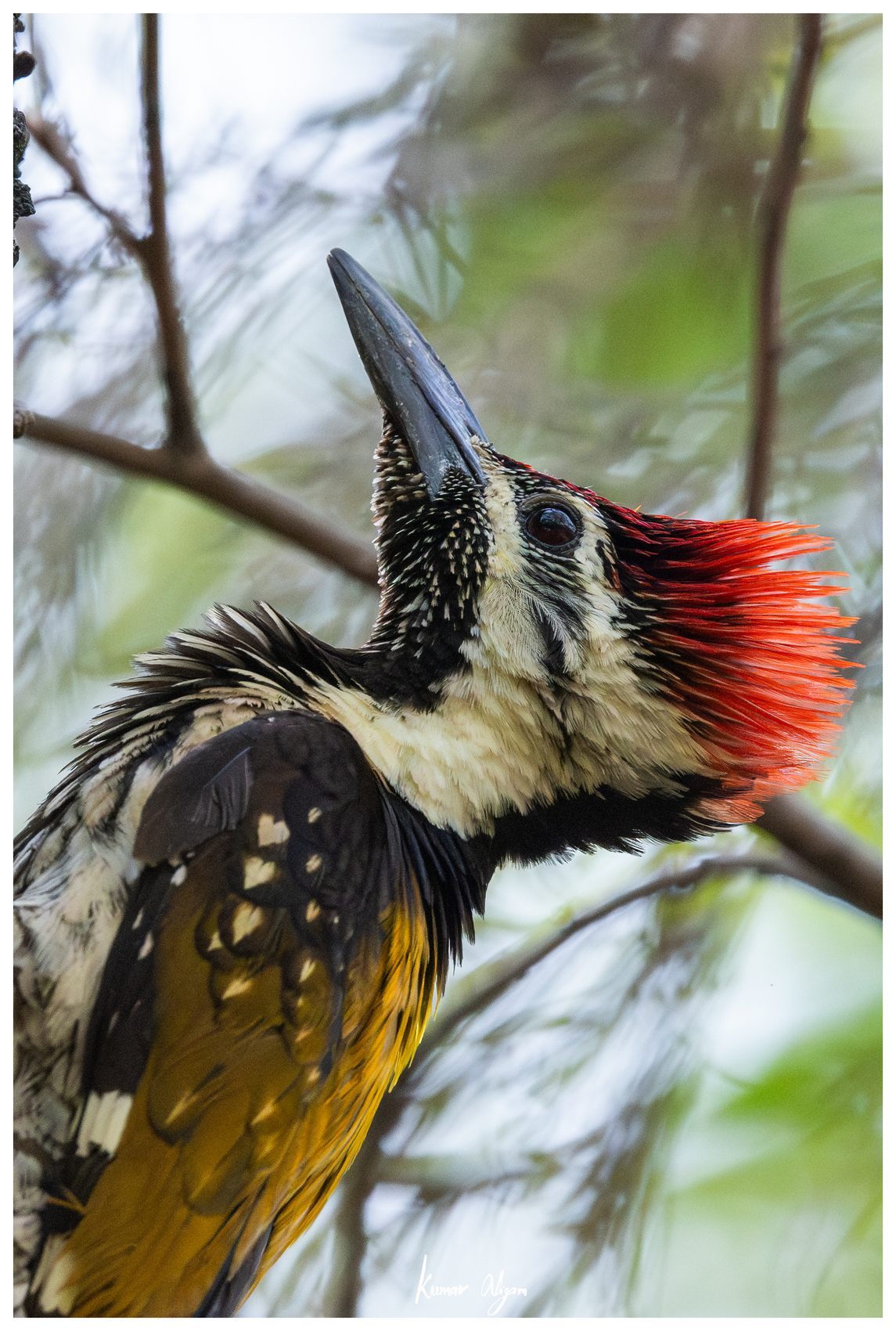
Chapter Eight
The Raid
One starling disappeared into the cavity.
The Flameback came back almost at once. I could see him rush the trunk, but he was a beat too late, and a beat was all it took. The intruder was already inside the chamber he had spent days building. For a few long seconds everything that mattered was happening in the dark, out of sight, where neither I nor the owner could reach it. When the starling appeared again, it looked out from the doorway with the calm of a bird that had already done what it came to do.
Chapter Nine
A Silent Tragedy
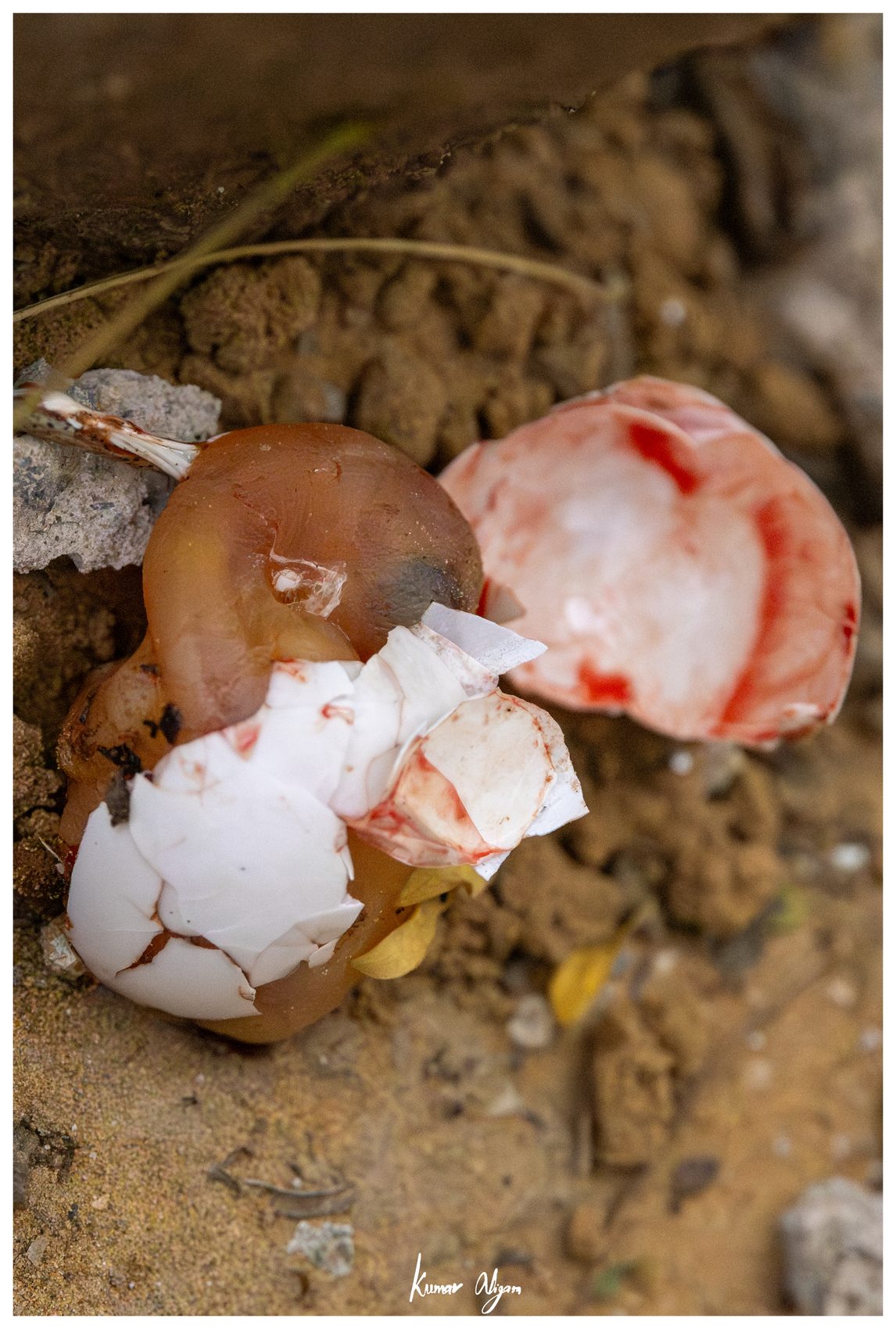
The cost of those few seconds was lying on the ground beneath the tree.
One of the Flameback's eggs had been broken. The shell was scattered across the soil a short way from the trunk, the contents already soaking into the earth. I want to be honest about what these photographs can and cannot tell you. I cannot say for certain whether the egg was destroyed on purpose, to clear out a rival brood, or whether it was broken by accident during the struggle inside that narrow space. Both of these things have been recorded among birds that compete for cavities. From where I was standing, I could only photograph the result.
What was not in any doubt was the loss. Days of work, and one egg of the next generation, gone in about the time it takes to read this sentence.
Chapter Ten
Nature Has No Villains
It would be easy to leave this story with the starling cast as the villain. Standing there with the broken shell in my frame, I felt that pull myself.
But the wild does not deal in villains. The starling was not acting out of cruelty. It was trying to secure a safe place for its own eggs, in a season when one good cavity can be the difference between chicks that survive and chicks that do not. The woodpecker was not being aggressive for the sake of it. It was defending days of its own work, and the family it had been getting ready for.
Both birds were doing exactly what millions of years had shaped them to do. One was built to make a home. The other was built to find one. On this particular morning, at this particular tree, those two honest instincts could not both win.
Behaviour, side by side
| Black-rumped Flameback | Brahminy Starling |
|---|---|
| Carves its own nesting cavity. | Cannot excavate a cavity of its own. |
| Invests several days in building the nest. | Searches for cavities that already exist. |
| Defends the entrance with displays and lunges. | Relies on persistence and repeated pressure. |
| Has the greater size and physical strength. | Has numbers, timing and patience. |
| Risks losing weeks of effort in a moment. | Risks finding no nesting site at all. |
Why this matters
A hole in an old tree is rarely just a hole
There is a larger reason to care about a quarrel over a single cavity.
An old tree is not simply standing wood. Every cavity in an old trunk is valuable property, and it rarely serves only one tenant across its life. The hole a woodpecker cuts this year may shelter starlings the next, an owl the year after that, and in the seasons that follow a squirrel, a family of bees, a small reptile, or any number of other lives. One doorway, carved once, can house a whole run of neighbours.
When the old trees come down, all of that quiet housing comes down with them. We do not only lose a tree. We lose the homes of everyone who was ever going to live inside it.
Behind the lens
One morning, held from start to finish
This behaviour did not unfold in a single dramatic instant. It came together slowly, across several hours of standing still and watching. I made a decision early that morning not to chase one clean portrait, but to try to hold the whole thread instead, from the digging and the defending to the long siege and the loss at the end.
Sequences like this are rarely seen from beginning to end, and rarer still to record in full. I am grateful that the tree let me stay, and a little heavy that this is how the morning chose to finish.